Data Structures 09 - Linked Queue
Code
#include <stdio.h>
#include <stdlib.h>

/**
 * Node structure definition for a linked queue.
 */
typedef struct LinkNode{
	int data;
	struct LinkNode* next;
}*LinkNodePtr;

/**
 * Linked queue structure definition.
 */
typedef struct LinkQueue{
	LinkNodePtr front;
	LinkNodePtr rear;
}*LinkQueuePtr;

/**
 * Initialize an empty queue.
 */
LinkQueuePtr initQueue(){
	LinkQueuePtr resultPtr = (LinkQueuePtr)malloc(sizeof(struct LinkQueue));
	// Create a head node; its data is not important.
	LinkNodePtr headerPtr = (LinkNodePtr)malloc(sizeof(struct LinkNode));
	headerPtr->next = NULL;

	resultPtr->front = headerPtr;
	resultPtr->rear = headerPtr;
	return resultPtr;
}// End of initQueue

/**
 * Output the elements in the queue.
 */
void outputLinkQueue(LinkQueuePtr paraQueuePtr){
	LinkNodePtr tempPtr = paraQueuePtr->front->next;
	while (tempPtr != NULL) {
		printf("%d ", tempPtr->data);
		tempPtr = tempPtr->next;
	}// End of while loop
	printf("\r\n");
}// End of outputLinkQueue

/**
 * Enqueue operation.
 */
void enqueue(LinkQueuePtr paraQueuePtr, int paraElement) {
	// Step 1: Create a new node
	LinkNodePtr tempNodePtr = (LinkNodePtr)malloc(sizeof(struct LinkNode));
	tempNodePtr->data = paraElement;
	tempNodePtr->next = NULL;

	// Step 2: Link the new node to the end of the existing queue
	paraQueuePtr->rear->next = tempNodePtr;

	// Step 3: The new node becomes the new rear
	paraQueuePtr->rear = tempNodePtr;
}// End of enqueue

/**
 * Dequeue operation.
 * @return The value of the front element
 */
int dequeue(LinkQueuePtr paraQueuePtr) {
	int resultValue;
	LinkNodePtr tempNodePtr;

	// Step 1: Check if the queue is empty
	if (paraQueuePtr->front == paraQueuePtr->rear) {
		printf("Queue is empty.\r\n");
		return -1;
	}// End of if

	// Step 2: Modify the queue structure
	tempNodePtr = paraQueuePtr->front->next;
	resultValue = tempNodePtr->data;
	paraQueuePtr->front->next = paraQueuePtr->front->next->next;

	if (paraQueuePtr->rear == tempNodePtr) {
		paraQueuePtr->rear = paraQueuePtr->front;
	}// End of if

	// Step 3: Free space
	// free(tempNodePtr);
	tempNodePtr = NULL;

	// Step 4: Return the result
	return resultValue;
}// End of dequeue

/**
 * Unit test function.
 */
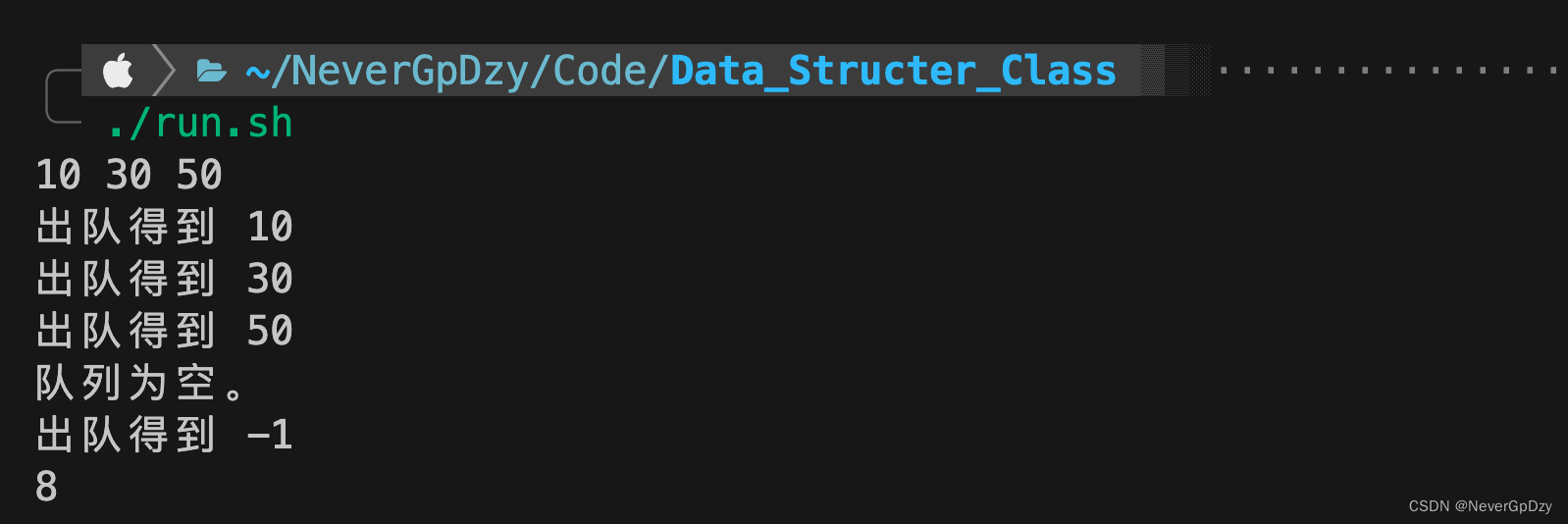
void testLinkQueue(){
	LinkQueuePtr tempQueuePtr;
	tempQueuePtr = initQueue();
	enqueue(tempQueuePtr, 10);
	enqueue(tempQueuePtr, 30);
	enqueue(tempQueuePtr, 50);

	outputLinkQueue(tempQueuePtr);

	printf("Dequeued %d\r\n", dequeue(tempQueuePtr));
	printf("Dequeued %d\r\n", dequeue(tempQueuePtr));
	printf("Dequeued %d\r\n", dequeue(tempQueuePtr));
	printf("Dequeued %d\r\n", dequeue(tempQueuePtr));

	enqueue(tempQueuePtr, 8);
	outputLinkQueue(tempQueuePtr);
}// End of testLinkQueue

/**
 * Main function.
 */
int main(){
	testLinkQueue();
	return 1;
}// End of main
Code Summary: This code is an implementation of a linked queue, including queue initialization, enqueue, dequeue, and output queue element functions. Below is a detailed explanation of each part:
-
Header files and structure definitions:
#include <stdio.h>and#include <malloc.h>include the standard I/O library and memory allocation library.typedef struct LinkNodedefines the node structure for the linked queue, containing an integer datadataand a pointer to the next nodenext.typedef struct LinkQueuedefines the linked queue structure, containing pointers to the queue front and rearfrontandrear.
-
initQueuefunction:- Creates an empty linked queue, allocating memory for the queue structure and head node.
- The head node's data is not used; it only serves as the start of the queue, and its
nextpointer is initiallyNULL. - Both the
frontandrearpointers of the queue point to the head node.
-
outputLinkQueuefunction:- Traverses the queue, starting from the node after the head node, until it encounters
NULL, outputting each node's data.
- Traverses the queue, starting from the node after the head node, until it encounters
-
enqueuefunction:- Creates a new node, places the data into the node, and sets the
nextpointer toNULL. - Links the new node to the end of the queue and updates the queue's
rearpointer to point to the new node.
- Creates a new node, places the data into the node, and sets the
-
dequeuefunction:- Checks if the queue is empty; if empty, outputs an error message and returns
-1. - Removes a node from the front of the queue, gets and returns that node's data.
- Updates the queue's
frontpointer; if the removed node is the only node in the queue, therearpointer also needs to be updated. - Frees the memory of the removed node and sets the pointer to
NULL.
- Checks if the queue is empty; if empty, outputs an error message and returns
-
testLinkQueuefunction:- Initializes a queue, performs enqueue operations, then outputs the queue contents.
- Performs dequeue operations, outputting the value each time.
- Performs enqueue operations again and outputs the queue contents.
-
mainfunction:- Calls the
testLinkQueuefunction to run unit tests; this is the program entry point.
- Calls the
The entire code implements the basic operations of a linked queue and demonstrates how to use these functions to operate the queue through the testLinkQueue unit test function.
Running Result